
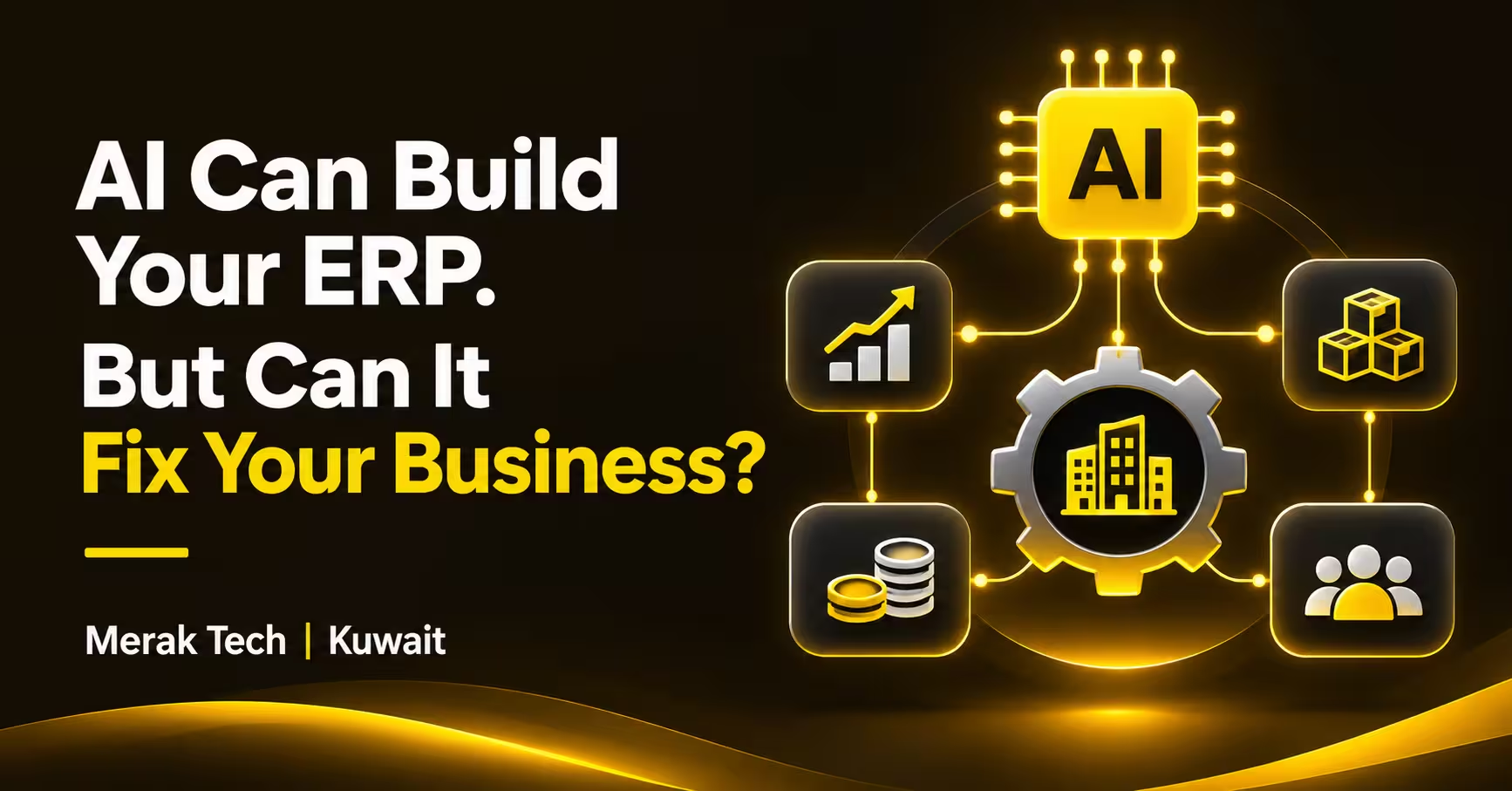
AI Can Build Your ERP. But Can It Fix Your Business?
AI can now write Odoo modules, set up automations, and build working applications in a fraction of the time it used to take. A task that took a developer a week can sometimes be done in an afternoon.
That is real progress, and at Merak Tech we use it every day. But after years of implementing ERP systems for businesses in Kuwait, I keep coming back to one simple truth:
A badly managed business with powerful software is still a badly managed business.

Speed Was Never the Real Problem
When an ERP project fails, it is rarely because the code was written too slowly. It fails because nobody agreed on how the business should actually run.
Stock counts don’t match because three people record goods received in three different ways. Invoices are late because sales and finance use different price lists. Reports are useless because the data going in was never clean. AI can build the screens and the automations in minutes, but it cannot decide which of those three processes is the right one. That decision belongs to people who understand the business.
Automating the Wrong Process Makes Mistakes Happen Faster
This is the part that worries me most about the “just let AI build it” mindset.
If your approval process is broken, automating it means broken approvals go through faster. If your inventory logic is wrong, an automated reorder rule will order the wrong stock, on time, every time. Software doesn’t question the process you give it. It just runs it at scale.
So before we write a single line of code, the first questions are always about the business: How do you sell? How does stock move? Who approves what? Where do the numbers come from, and who trusts them?
What ERP Implementation Really Involves
A successful Odoo project is a business project with software inside it. It means understanding how these areas fit together:
- Sales: how quotes, discounts and orders really flow, not how the brochure says they flow.
- Inventory: warehouses, transfers, returns and the exceptions everyone handles “manually for now”.
- Finance: accounting rules, approvals, local requirements and the reports management actually reads.
- Operations: purchasing, delivery, service and the hand-offs between departments.
- People: who will use the system every day, what they need, and what will make them stop using it.
The last one is the most underrated. The best-configured system fails if the team quietly goes back to Excel and WhatsApp.
Where AI Genuinely Helps
I’m not against AI. Quite the opposite. Used in the right place, it changes what a small team can deliver:
- Writing and testing custom Odoo modules much faster
- Building reports, dashboards and integrations in less time
- Cleaning and migrating data from old systems
- Automating repetitive tasks once the process is right
- Giving users quick answers and guidance inside the system
The difference is the order. Fix and agree the process first, then let AI make it fast.
Odoo + AI + Business Expertise
At Merak Tech, this is how we approach every implementation. Odoo gives the business one connected platform. AI speeds up how we build, migrate and automate. And business expertise makes sure we are building the right thing in the first place.
Take any one of the three away and the results suffer. Odoo without the right process is just a more expensive way of doing things badly. AI without business understanding builds the wrong thing faster. Expertise without good tools moves too slowly to keep up.
AI Won’t Replace Great ERP Consultants
It will make the good ones more valuable.
When building software becomes cheap and fast, what becomes scarce is the judgement to know what to build, what to change in the business and what to leave alone. A consultant who can sit with a business owner, map the real process, spot the problem and then use AI to deliver the fix in weeks instead of months is worth more today than ever.
The future isn’t about who can build software faster. It’s about who can make businesses run smarter.
FAQs
Can AI build an ERP system on its own?
AI can write a lot of the code, configuration and automations. It can’t decide how your business should run, clean up conflicting processes or get your team to adopt the system. That still needs people who understand the business.
Is Odoo a good ERP for businesses in Kuwait?
Odoo works well for many Kuwaiti businesses because it covers sales, inventory, accounting, purchasing and more in one platform, and it can be customized for local needs. The result depends on how well it is implemented.
Why do ERP implementations fail?
Most failures come from unclear processes, poor data and low user adoption, not from the software itself. Automating a broken process only makes the problems happen faster.
How does Merak Tech use AI in Odoo projects?
We use AI to speed up custom development, reports, data migration and automation. We use it after the business process has been mapped and agreed, so we automate the right things.
Final Thought
AI has changed how fast we can build. It hasn’t changed what makes a business work: clear processes, clean data and people who use the system with confidence. Get those right, and AI becomes a real advantage instead of a faster way to make the same mistakes.
Looking to run your business on Odoo the right way? Let’s talk. Merak Tech | Kuwait.